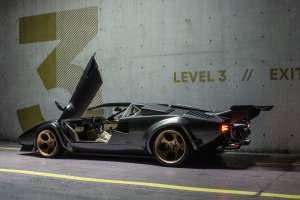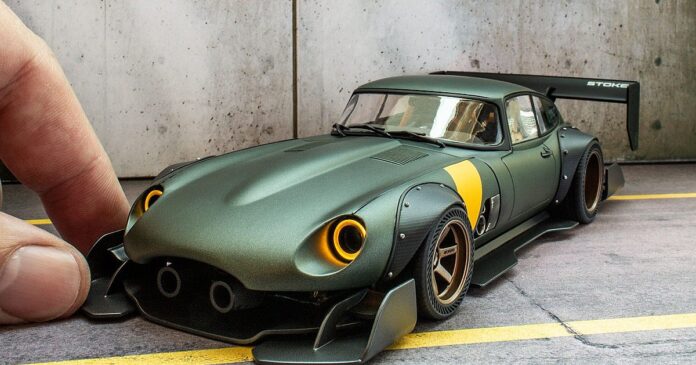
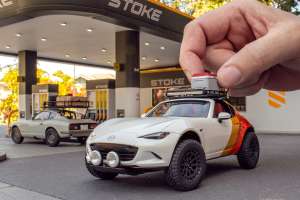
We first came across the work of Martin Aveyard through Instagram. He posted a photo of a well-stanced early ’80s Volvo 240 Turbo, carrying stacks of flat-pack IKEA boxes, parked at a gas station pump. As suckers for tastefully-modded vintage Swedish autos, we were awestruck and envious of the driver. Then we noticed what appeared to be a comically large hand Photoshopped into the image, placing the flat-packs onto the roof rack of the Volvo. This wasn’t Photoshop; Martin Aveyard—who goes by the name Stoke Models—had created a scaled-down universe that satiated our wildest automotive desires while causing us to scratch our heads and ask, “How is this possible?”
We sat down with Aveyard to understand his modeling process, the inspiration behind his craft, and why all of his work will always remain one of a kind.
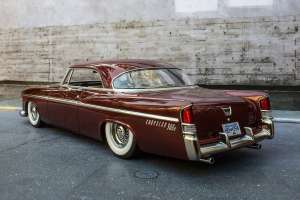
Can you tell us a bit about Stoke Models?
My name is Martin Aveyard and Stoke Models is the brand that I build scale models under. I make a lot of different things, but I always use Stoke as the name. It’s a nod to my birthplace in England, Stoke-on-Trent.
What got you into making scale car models?
I grew up in the ’70s and ’80s, and building scale models was a lot more common then. I’ve always been into cars and have built models off and on my whole life. I started building again at the end of 2019 after not building anything for almost 15 years.
What’s your background?
I’m an art director/graphic designer for a small advertising agency. My career has given me a skill set that seems to be perfect for building and presenting models: conceptual and visualization skills, 3D digital modeling, graphic design, physical craftsmanship, and photography.
What got you into cars?
Matchbox and Hot Wheels, probably. I’ve been into cars as long as I can remember and have spent my share of time working on and fixing older cars. I grew up watching my dad fix whatever car we had at the time. Also, my friend and I each had old junkers in our teen years that required a lot of repairs. Mine was a beat-up 1975 Datsun 280Z.
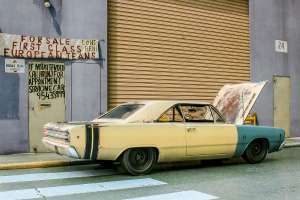
You’ve consistently said that you won’t sell the models that you create and build. We totally respect that … but why?
I’m really trying to keep this as a hobby. As soon as money enters the equation, it becomes work. My day job in design is me selling my creative output to clients. I have to meet their brief and incorporate their input and feedback into the final product. I enjoy the collaboration most of the time, but creating the car models is where I get to make all of the creative decisions to execute exactly what I want. As soon as I start thinking about whether or not a model would sell, I’ve started compromising that.
You build backgrounds and sets as well as the cars. What inspired you to take scale modeling that far?
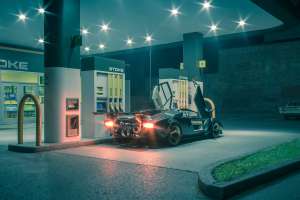
When I started building again, it was just a nice, quiet hobby, but as soon as I started taking photos of the finished models, I realized that I enjoyed making the finished builds look as realistic as possible. I probably enjoy the photography as much as the building itself. Most of the backgrounds I use are just printouts of photos that I’ve taken or found online. I started building my gas station diorama in early 2020, and it really became my COVID project. The goal was to create a scale environment where I had multiple shooting angles and options for presenting the models.
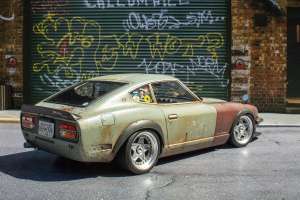
The detail of the cars that you build suggests that there are stories behind them, like the patina of your Fairlady Z build. Do you imagine what each car’s history and story is? Who the owner might have been? What kind of life the car may have lived?
I think I do sometimes, like the Z or the Volvo with the IKEA boxes on top, but I’m usually more likely to just build whatever I think looks cool. Or I imagine how I would build the car in real life.
How do you choose the cars you’re going to build?
The first criteria for me is that the kit must be accurate in terms of proportions. There are a lot of kits out there that, no matter how much work you put into them, they are still going to look like a model because of some fundamental flaws. After that, it’s really just about cars that I like. I think I have pretty broad taste in cars as subject matter—European and JDM, as well as the occasional hot rod or muscle car. I’ve also realized that I have a thing for three-box coupes; I seem to have built a bunch of them.
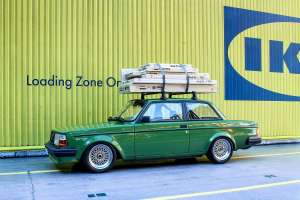
Many of your models are “custom,” as in, not stock. Why is that?
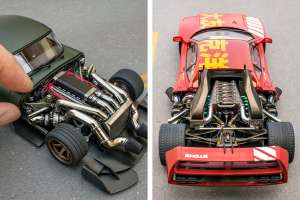
I can appreciate a well-built replica of an original car, and have done that a few times, but I love being able to apply my own creativity or combine inspiration I’ve seen online into a new custom build. It has really become a creative outlet to try out different ideas and concepts. Getting my first 3D resin printer just opened up the possibilities of what I could do in terms of custom wheels, aerodynamic parts, and other details.
Where do you get inspiration for your builds, or in general?
Mostly from Instagram, to be honest. It has really democratized the distribution of creativity. It used to be that I would see a build in a magazine only after it had been selected by the editorial team that had a certain taste or style. I’m currently building a Baja Beetle that’s heavily inspired by a guy from Tennessee with 160 followers. I never would have seen his build if not for Instagram.
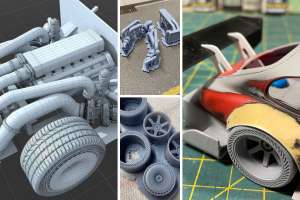
You use a lot of 3D printing in your builds. How did you get started working with that technology?
I had done some 3D modeling for work and for fun, starting about 20 years ago. I’ve always kept a foot in it, so when I got into 3D printing, I already had an ability to digitally model my own parts.
There was a lot of excitement about 3D printing being the future of manufacturing, but the volume has turned down a bit. Do you believe 3D printing will be a significant part of the future?
Yeah, I think it will. Manufacturers will figure out the best way to use it in their production lines, cars or otherwise. I think for home use, it’s not quite at appliance-level convenience yet, and I think that still scares people off. The resin printers are easy to run prints on, but messy to clean up, smelly depending on what resin you’re using, and you still get failed prints sometimes. I think the hassle will reduce over time as the printer manufacturers sort out some of those sticking points.
For someone thinking about getting into bashing some plastic together, where should they look to get started?
YouTube for sure. I’ve learned so much from watching videos about painting and detailing techniques from car modelers as well as military and train modelers—a lot of the skills are transferable. The other recommendation I always make is to start with a Tamiya model kit. They’ve got a huge range of subjects, and the kits just go together so well that you can focus on the paint and assembly and not have to fight the kit to get the pieces together.
What’s next for Stoke Models?
Hopefully, a 3D scanner and vacuforming machine. I’ve built models where I’ve replaced over half the kit pieces, so I can really see myself moving into completely creating my own designs and 3D printing the whole thing. I’d use the vacuformer to make the windshields and glass bits.
Stoke Models | Instagram
This article first appeared in Iron & Air Magazine, and is reproduced here under license.
Interview by Gregory George Moore | Images by Martin Aveyard