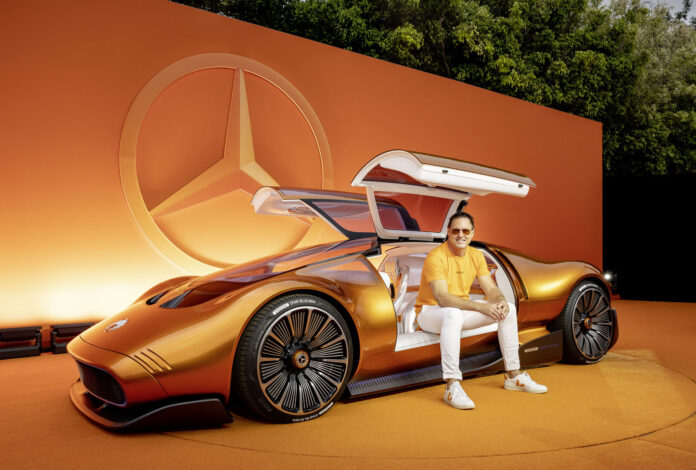
Born in Essen in 1968, Wagener studied industrial design at the University of Duisburg-Essen before specialising in transportation design at London’s Royal College of Art. His career began with stints at Volkswagen, Mazda and General Motors before he joined Mercedes in 1997 as a transportation designer working under its then design boss, Bruno Sacco.
His rise through the ranks was rapid. By 1999, he was managing exterior and interior styling for the R-Class, ML and GL. In 2002, he moved to passenger car development, overseeing design for the A-Class, B-Class, C-Class, E-Class, CLK, CLS and McLaren SLR. A brief transfer to Mercedes’ advanced design studio in California in 2006 preceded his 2007 promotion to director of design strategy and global advanced design.
When he assumed overall leadership, Wagener broke decisively with long-time Mercedes tradition and processes. His predecessors, Karl Wilfert, Friedrich Geiger, Bruno Sacco and Peter Pfeiffer, had all trained as engineers. Wagener was the first pure designer to lead Mercedes design, a distinction that those who worked under him say enabled the “sensual purity” shift he championed.
If one car exemplified Wagener’s impact, it was the CLS, the four-door coupé that gave Mercedes a sleeker, more desirable model to sell alongside its more conservative saloons. From there, the brief widened with similarly styled models such as the A-Class and CLA to chase younger buyers. Other key models designed under his leadership include the gullwinged SLS and the current G-Class.
Elevated to the Mercedes board in 2016 as chief design officer, Wagener oversaw design for all group brands, including AMG, Maybach, Mercedes-Benz Vans, EQ and Smart. His remit extended beyond cars: he has led design teams on helicopters, luxury yachts and, most recently, the Mercedes-Benz Places residential towers in Dubai and Miami.
Wagener’s tenure has not been without controversy. His design for Mercedes’ EQ electric cars, particularly the EQS saloon, drew heavy criticism for its aerodynamically optimised but visually controversial jelly-bean form. Sales of this flagship EV failed to live up to early expectations, and subsequent EQ EVs have closely resembled their combustion counterparts – acknowledgment that Wagener’s more radical design was “ahead of its time”, as he himself suggested.

