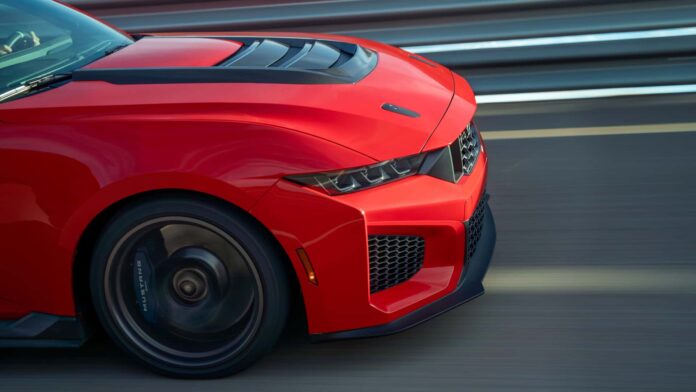
- Ford had a big week at the Detroit Auto Show, unveiling a new high-performance Mustang and Bronco, and previewing the season ahead for several racing-related initiatives.
- Ford’s once-disparate motorsports operations are now under one roof, dubbed Ford Racing, with more factory involvement than ever.
- In an interview with Motor1, Ford CEO Jim Farley explained the business case for racing—including becoming ‘the Porsche of off-road.’
There’s an old saying in the motorsports world: “The best way to make a small fortune in racing is to start with a large one.”
That’s true for both small privateer teams and huge global automakers. Even if the passion for racing is what gets a lot of people in the auto industry out of bed every morning, the financial returns on motorsports investments are often hard to quantify beyond vague gains in “brand awareness.”
But at Ford Racing’s big debut at the Detroit Auto Show this week, Ford’s CEO Jim Farley made clear that its latest moves aim much higher than being a branding exercise.
“Ford Racing can’t be a marketing department anymore,” Farley told Motor1 in an interview on Thursday. “Our idea for Ford Racing is that they actually engineer road vehicles. They’ll engineer our next-generation supercars, the new Mustang SC.”
43
Source: Ford
While the 2026 Detroit Auto Show was a sleepier affair than it has been in decades past, Ford used the event as a kind of coming-out party for its biggest performance-focused initiatives in 2026 and beyond. That included the debut of the new, supercharged Ford Mustang Dark Horse SC, the performance-focused Ford Bronco RTR, its new technical partnership with Red Bull Racing for Formula 1, the latest on its in-house WEC effort, and more.
But Farley, himself an avid racer who has competed both on and off the pavement, said the ultimate goal for Ford is to make its consumer cars better—and that goes deeper than sticker and badge packages.
“Ford Racing used to just go racing,” Farley said. “They never had the transfer function back into the company like Porsche did or Ferrari did with their racing effort. It’s a big change for Ford.”

Jim Farley, CEO of Ford, Mark Rushbrook, Ford and Red Bull Racing Team Principal Christian Horner
The two European motorsports giants came up frequently in our conversation. Farley reiterated that he wants Ford to be seen as “the Porsche of off-road,” synonymous with competing and winning when the pavement ends. “Unlike Jeep, with its military [heritage], or the Defender for commercial use in Africa, our authentic off-road credibility comes from racing,” Farley said. “The other example is the Range Rover. We really see off-road work use as another way to build credibility.”
Trucks and SUVs are already big business for Ford—arguably, the business. But even as the maker of America’s best-selling vehicle, the F-150, the competition is heating up.
‘Our idea for Ford Racing is that they actually engineer road vehicles. They’ll engineer our next-generation supercars.’
The American auto industry, and increasingly the European one, has tilted heavily toward SUVs and trucks in recent years. Many automakers have posted strong sales gains by emphasizing larger, more off-road-focused SUVs, with specialized trims and option packages emerging as major profit drivers.
Think of it this way: if you’re already buying a Mercedes G-Class or a Land Rover Defender, why not pull the trigger on the most rugged, specialized, trail-ready one you can get? According to one analysis, the entire off-road vehicle market is expected to be a $21 billion business by 2033.
35
Source: Ford
Ford is seeing the benefits of that shift right now. According to the automaker’s fourth-quarter earnings report, off-road performance trims—the Raptor, Tremor, Timberline, FX4, and so on—accounted for nearly 21 percent of US sales last year. Sales of off-road performance trims rose nearly 18 percent last year, totaling over 450,000 vehicles sold.
In other words, people buy this stuff. And Farley said he sees Ford—which has moved away from sedans and smaller vehicles in the United States to primarily focus on SUVs and trucks—doubling down on racing to make those vehicles stand out. And the playbook has worked before, Farley said.
“The [F-150] Raptor itself was inspired by Baja racing,” he said. “I funded that 15 years ago out of my marketing department, to go race in Baja and then turn that into a production vehicle.” Today, it’s hard to imagine Ford’s performance lineup without the high-performance Raptor truck, which has since become a treatment for the Bronco SUV and the smaller Ranger.
That sales success could give Ford some needed relief from the regulatory whiplash and changing consumer tastes that have hit reset on the entire American auto industry.
Farley reiterated that he wants Ford to be seen as ‘the Porsche of off-road.’
In December, Ford announced $19.5 billion in losses to retool its entire electric vehicle program, including cancelling the groundbreaking F-150 Lightning amid slower sales and chronic unprofitability. Though the Michigan-based automaker builds nearly all of its US models domestically, it still incurred about $1 billion in new tariff costs. And no longer under the gun to electrify quickly now that the Trump administration dialed back fuel economy rules, Ford has some freedom to lean more on profitable gas-powered vehicles—at least, for now.
Farley himself has warned of the dangers of having to compete with China’s automakers in the EV space, both globally and potentially at home. Long-term, Ford is hanging its electric hopes on the upcoming Universal EV Platform, starting with a $30,000 truck meant to compete with China’s best on production costs and profits.
For now, making better cars through racing efforts could give Ford the financial edge it needs. That goes beyond off-road racing as well, he said. “Racing, grassroots racing, selling race cars like Porsche has done for a long time—that’s big business,” Farley said.
“We have a [Mustang] GT4 and GT3 that we actually build for customers. We build race cars for our customers. When I go to the racetrack now, at Sebring or Daytona or Spa or Le Mans, I’m meeting with our customers who buy our race cars. They buy crash parts, and they buy engines, they buy all sorts of things. And that’s a separate business as well,” he said.
But even more crucial, he said, is making better and better road cars, like the Mustang GTD. “The most important part of this whole thing is translating, on the off-road side and the on-road side, the racing technology and putting it into our core product—putting it into our ‘hero products’.”

