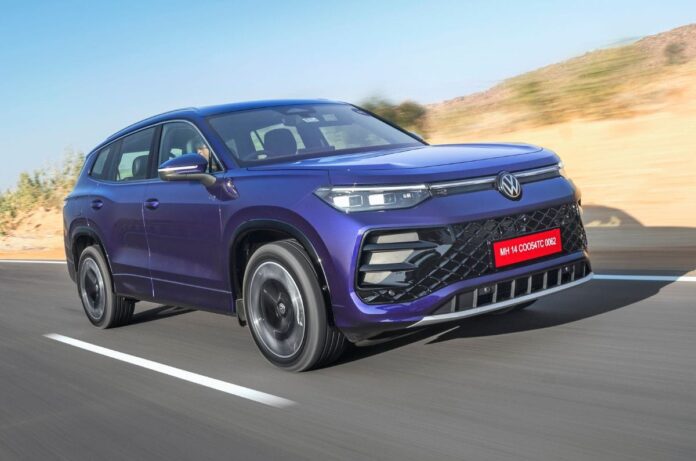
What we have here is the Volkswagen Tayron, and there’s a reason it looks familiar. Think of it as an XL-sized Tiguan with the big advantage of the added length being the inclusion of a third row of seats. In simple terms, the Tayron is to the new Tiguan what the Tiguan Allspace was to the old one.
Volkswagen Tayron Exterior Design and Engineering –
There’s a clear visual connection to the Tiguan, but look closely, and you’ll find a few differences in the details. The Matrix LED headlights are slightly different, and there’s a slimmer panel between the lights too. The de rigueur full-width light bar is part of the lighting package, and even the VW logo illuminates. The bumper design changes – though, with this too being a sporty R-Line version, there’s a large gloss-finished mesh section, wide air intakes with prominent slats and aero channels at the edges.
Long wheelbase and rear overhang make Tayron look substantial
The real difference is evident in profile. The wheelbase is 109mm longer, while the extended rear overhang pushes overall length to 4,792mm – a massive 253mm more than the Tiguan. The gloss effect makes its way to the sides, too, on the wheel arches and mirrors. Styling is clean with neat lines, and we really like how the shoulder line swells from the rear doors to the tail and the silver surround that dips down from the roof to the rear glass section.
At the back, there are intricately done tail-lights with LED elements. Of course, there’s a light bar too, and even the VW logo glows. There’s a glossy mesh-like look for the lower portion of the bumper, but the exhaust pipes, sadly, remain hidden from view.

The Tayron is an attractive SUV, and the contrasting black elements on this R-Line do help lend some sportiness to the design. Do note that a lower-trim version of the Tayron comes later this year and would likely get simpler detailing and wheels.
The Tayron is a sister model to the Skoda Kodiaq.
Under the skin, the monocoque-bodied Tayron has much in common with the Skoda Kodiaq. They are built on the same platform, are nearly identical in size and are powered by the same engine.
Volkswagen Tayron Interior Space and Comfort –
Step inside, and it’s immediately familiar Volkswagen territory, which means quality comes first. The Tayron delivers the solid door shut and premium tactility we associate with the brand. Most surfaces you interact with feel high-quality, and the seats are comfortable, plush and suitably premium.
The steering wheel may not break new ground in design, but it’s well-finished and sensibly equipped with physical controls for key functions. Alcantara-like trim adds a sporty touch and works beautifully with the ambient lighting, which is superbly executed. At night, the combination of ambient lighting, crisp digital dials and the large touchscreen looks particularly impressive. Poke a little lower down, however, and you will encounter some harder plastics that feel less Volkswagen-like.
Minimalist dash is dominated by a 15-inch touchscreen
The dashboard is shared with the Tiguan and can best be described as minimalist. Physical buttons are absent, with almost all functions routed through the 15-inch touchscreen. Despite its laptop-rivalling size and appearance, the screen is well-positioned and doesn’t seem in-your-face. The screen layout is intuitive, with key information in large tabs and minimal menu layers. But the thing is, even the climate control and seat ventilation settings are bunched onto the screen (though they are always visible). Touch-type sliders below the screen can be used to alter temperature and volume but aren’t as tactile or satisfying to use as a physical button or knob.
The sole physical controller is a rotary knob at the centre console that can be used for volume, drive modes and ambient lighting themes. Do note there’s no traditional gear selector on the Tayron. Gear selection is handled by a stalk behind the steering wheel – something that’s surprisingly easy to get used to.
Relocating the gear selector has freed up considerable space on the centre console. Storage is generous, starting with two wireless charging pads concealed beneath a flip-up panel at the base of the dashboard, along with twin USB Type-C ports. Between the seats sits a removable cup holder module, while under the centre armrest is a large storage bin. The glove box is big, and the felt-lined door pockets are large too.
Middle-row seat offers slide and recline but doesn’t tumble forward for access to the third row
Second-row space is impressive, with good knee room and plenty of space to tuck your feet under the front seat. The 60:40 split bench slides fore and aft to balance second- and third-row space, and the backrest reclines by about 15 degrees. The middle-seat passenger won’t have it as nice, though. The high centre tunnel and contouring of the seat hamper comfort.
The middle row is best enjoyed by two, with the centre armrest folded down and its clever adjustable cup holder deployed – it swivels a couple of degrees for easier access.
The third row is not for everyone. Kerbside access requires you to slide the larger of the 60:40 split seats; the seat doesn’t tumble forward, and access is via a small opening. Space is also tight, with limited knee room and headroom for large adults. Short journeys are possible by balancing space between the rows, so long as you sit in order of height.
What does impress is the luggage space. Even with all seats up, there’s enough room for cabin bags. Fold the third row, and luggage capacity expands to a massive 850 litres. Dropping the second row too opens up a cargo van-rivalling 1,900 litres. Also worth highlighting is that a powered tailgate – missing on the Tiguan – is standard here, complete with gesture control.
Volkswagen Tayron Features and Safety –
Powered and ventilated front seats, a 360-degree camera and a powered tailgate are part of extensive feature set
The Tayron gains several features that were missing on the Tiguan. The broad and accommodating front seats now pack power adjust, memory and ventilation, in addition to massage and heating that were included on the Tiguan. Another welcome addition is a 360-degree camera, although the resolution should have been better for a vehicle at this price point. The Tayron R-Line also gets a 10.25-inch digital instrument cluster with multiple themes, a head-up display, three-zone climate control, a panoramic sunroof and an 11-speaker Harman Kardon audio system.
Rear passengers also get sunshades for the large windows – a real boon on hot days. What’s missing, however, is a boss mode to adjust the front passenger seat from the rear.
ADAS is part of the package
The Tayron is equipped with a suite of ADAS features, including lane-keep assist, automatic emergency braking, driver-drowsiness detection, adaptive cruise control and auto-park. Lane-keep assist and adaptive cruise control worked well on the wide and well-marked roads around Jaisalmer. Safety equipment also includes nine airbags (including a centre airbag), ABS, electronic stability control, tyre-pressure monitoring and hill-hold assist.
Volkswagen Tayron Performance and Refinement –
Tayron is solely offered with a 2-litre turbo-petrol engine
Powering the Tayron is the same 2.0-litre turbo-petrol engine as the Skoda Kodiaq, producing 204hp and 320Nm. Power is sent to all four wheels via a 7-speed dual-clutch automatic transmission. Before you ask, there’s no diesel option, though the turbo-petrol goes all out to make converts of the modest, ardent diesel-heads.
VW’s EA888 engine remains one of the best four-cylinder units in the business. It’s smooth, refined and responsive, and instantly likeable. The engine doesn’t bunch up all 204hp but delivers its power over a wide spread. Mind you, the Tayron is quick. Volkswagen claims 0-100kph in 7.3 seconds and a top speed of 224kph.
Sporty engine note complements strong performance
The engine’s sound adds to the experience too, with a gravelly note at low speeds that becomes throatier as pace builds. The dual-clutch gearbox complements the engine well, delivering smooth shifts, especially on the highways, and adapting neatly to driving style. On the wide roads around Jaisalmer, low-speed hesitation – a common DSG trait – wasn’t evident, though real-world city testing will tell the full story. Also, real-world fuel economy in chock-a-block city driving is yet to be tested.
Volkswagen Tayron Mileage –
Volkswagen Tayron Ride Comfort and Handling –
Drive modes help tweak experience, but Dynamic Chassis Control isn’t included
You can alter the experience with drive modes that tweak steering, engine response, AWD behaviour and ESC settings. Switch from Comfort to Sport, and the Tayron feels noticeably more alert, with added steering weight and a keener character.
That said, one feature keen drivers may miss is Dynamic Chassis Control (or damper control in simple English), which was offered on the imported Tiguan. At higher speeds, there’s some vertical movement, though it’s never unsettling. Overall, the Tayron feels sure-footed and stable, even at Autobahn-style speeds.
Despite large size, Tayron is easy to drive
Handling is classic Volkswagen – tidy, predictable and confidence-inspiring rather than overtly exciting. Crucially, it doesn’t feel as long as it is. The steering offers reassuring weight at speed yet remains light and easy in the city, making the Tayron far more user-friendly than something like a Fortuner. The Tayron gets VW’s 4Motion all-wheel drive, and that does add a safety net in poor weather or when the surface deteriorates.
Ride quality is generally comfortable, though at urban speeds, there’s a hint of firmness over potholes and rumble strips.
Volkswagen Tayron Value for Money –
Volkswagen Tayron expected price is Rs 46 lakh-48 lakh ex-showroom
The Tayron will be launched this month, and notably, it will be assembled in India from day one, whereas the Tiguan was brought in as a full import. Local assembly should help the larger and more wholesome Tayron sport a lower price tag. We expect Tayron R-Line prices to be in the same ballpark as those of the Skoda Kodiaq L&K, at around Rs 46-48 lakh (estimated, ex-showroom). A lower trim version that comes later this year will bring the price down.
Fans of European cars will immediately connect with the Tayron. It looks contemporary, is well-equipped and has a feel-good factor about it. Downsides? The lack of physical buttons takes getting used to. Also, the Tayron is not ideal as a 7-seater, but those with only occasional use for the third row will love the massive luggage space that folding the seats opens up.
For someone happy to spend Rs 50 lakh on an SUV, the Tayron R-Line makes for a polished and well-rounded package that’s hard to ignore.

